

Avatar is so totally Jewish!
Permanent link All Posts
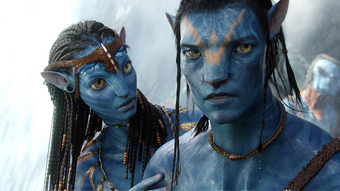
Just saw Avatar at Navy Pier’s Imax theater…LOVED IT!! Wow!! As I watched, I kept thinking about how this movie is totally Jewish. In fact, I think that the movie is so darn Jewish that Mr. Cameron should send a big fat royalty check (to the tune of 1.34 Billion) to JUF. That would be so great! (In the meantime, don’t forget to make your JUF donation this year!)
Anyway, here are some of the Jewish connections I noticed. Love to hear what you think:
1. The movie is long—really long—like 3 hours long—but good—just like a Shabbat service.
2. Hmmmm… a story about a little band of warriors with a lot of heart, but far less sophisticated weapons, who challenge a much better organized and equipped army in order protect their land? Sounds familiar...Oh, I know! It’s Chanukah!!
3. Neytiri, Jake’s Na’vi Beshert, is the embodiment of every gorgeous Israeli woman I ever dreamed of dating. She’s got swagger and confidence, she’s fierce, fearless, passionate, and at the same time she’s extremely loving and loyal once you win her respect. Sure, she might make you learn Hebrew and move to Israel, and she will likely dare you to jump off a huge tree, but know this—if you ever get attacked by a pack of wolves, (or ten angry terrorists) she’ll take em’ all down.
4. Na’vi, the name of the indigenous people of Pandora means “prophet” in Hebrew. The name of their god—Eywa if you rearrange the letters, spells Yawe…which is just like YAHWEH (the name of our God) and if you add just one letter to Tsahik, the name of the spiritual leaders of Na'vi clans, you get tzadik, the Hebrew word for a righteous person (as noted in other blogs).
5. The unlikely hero of the story, Jake Sully, had a physical impairment. He cannot walk. With the use of another body (the Avatar) Jake is able transform the world. Moses, one the greatest Jewish heroes of all time, also had a physical impairment. He was “slow of speech and slow of tongue” (Ex. 3:10) and like Jake, Moses, with the use of another body, (that of his brother Aaron, who had no trouble speaking), and with the help of God, (actually it was the other way around) overcomes the mighty Pharaoh.
6. The notion from the movie that “All living things are one—zalelu”—is Jewish. Note this story about the late Rabbi Isaac Kook, first chief Rabbi of Israel: One day Rav Kook was walking in the fields with a student when the young man carelessly plucked a leaf off a branch. Visibly shaken by this act, Rav Kook turned to his companion and said gently, “Believe me when I tell you I never simply pluck a leaf or a blade of grass or any living thing unless I have to. Every part of the vegetable world is singing a song breathing forth a secret of the diving mystery of creation.” For the first time the young student understood the meaning of showing compassion to all living things. (Spirit in Nature: Teaching Judaism and Ecology on the Trail, Biers-Ariel, Newborn and Smart, pg 22)
7. The big Tree—“Home Tree” is clearly like the Tree of Knowledge from the first story of Genesis and the Na’vi are living in the Garden of Eden. Problem is the evil General doesn’t heed Deuteronomy 20:19 which states, “when you wage war against a city…you must not destroy its trees.” When the tree is destroyed, the people are exiled, reminding us all of the destruction of the Temple in 70CE. The “Tree of Souls,” the center of the Na’vi’s religious and cultural life and a place where the Na’vi can connect to all the ancestors of the past, is an obvious metaphor for the Torah, which is a “Tree of Life to all who hold fast to it.” Like the “Tree of Souls”, the Torah is our connection to God, to our people past and present and our center of religious life. That is why when our enemies have persecuted us in the past, the first symbolic target in their crosshairs is the Torah.
8. Some say Pandora's floating "Hallelujah Mountains" were inspired by the Chinese Huang Shan mountains, I say the inspiration came from the following Midrash:
At the foot of Mt. Sinai, God's words boomed down upon the Israelites. The people stood, flabbergasted and stupefied with fear. Slowly, apprehensively, they moved closer. As they drew nearer, God lifted Mt. Sinai and held it over their heads: IF YOU ACCEPT MY TORAH, FINE! God said. IF NOT, YOUR GRAVES WILL BE UNDER THIS MOUNTAIN! The people shouted, WE ACCEPT!
9. When Jake becomes a Na’vi, we can’t help but be reminded of the process of becoming a Jew. As a rite of passage to become an adult Na’vi, Jake must tame and fly an Ikran, a terrifying wild birdlike creature. To become Jewish adults, we have to tame our nerves and fly by the seat of our pants during our Bar or Bat Mitzvah. After much practice, we find that we soar. Also, when Jake is completely immersed in Na’vi culture, to his surprise, he falls in love with their people, religion, culture and God. As is noted elsewhere, Jake’s trip to forests of Pandora does for him what an Israel trip does for many American Jews. Jake’s encounter then leads him to what I saw as the last scene in the movie—a beautiful conversion ceremony, not unlike what we have in Judaism. Jake, with the support of the entire community, the Kehilla, who are singing and swaying with total Kavanah, hears sacred words chanted, and awakens with his eyes open, now ready to see the world through new and excited eyes—much like the experience of someone who converts to Judaism and suddenly sees the world through Jewish eyes.
10. Finally, when the movie trailer opens Jake’s states that he wants to make a difference and hopes to find something worth fighting for. In other words, Jake is searching for his Holy Mission, his opportunity to impact the world for the better. This is ultimately a religious search and the point of Judaism—for each of us to find what God has put us on this planet to do and to serve that Holy Mission in a way that brings honor to ourselves, our families, our people and all of humanity. In a way, we Jews are just like the Jake character in the movie, searching for our best selves, always striving to learn what really matters in life and always making a positive difference in the lives of others. I think therefore, that it is more than mere coincidence the main character’s name is Jake. To us, he is Jacob, which is of course another name for ISRAEL—which really means that he is all of us.


.jpg)



