
Permanent link05/23/2013 
I could say what happened was purposeful. That it was a social experiment. A protest against the system. I could say I was joining the legions of folks like Ben Affleck who said he will live on $1.50 a day for five days to bring attention to folks living below the poverty level via the Live Below the Line campaign. And I think I could pull that off as the truth because I think you would believe me. But I am going to tell you the real truth because until this happened to me and my family, I only understood some of the work I do from a privileged distance. I had compassion but no experience.
This truth, (as many truths are), is embarrassing. It exposes me and my lifelong struggle with organization. One husband, two dogs and four kids later, I have gotten better, but at the same time life has gotten more complicated. And I’m not nearly perfect yet.
The day started like any other Friday. When I saw the bright yellow cardstock notice written in Spanish from (FILL IN THE BLANK) GAS, I didn’t pay much attention. I grabbed the rest of the mail and began sorting. Junk. Junk. Bill. Junk. Thank you note. Junk. And then I was back to the yellow cardstock.
I did take Spanish for a few years but I am pretty limited. If you want to say “let’s go to the beach!” or “I love swimming!” I’m your go-to gal. But I couldn’t translate “AVISO DE DESCONEXION DEL SERVICIO DE GAS NATURAL” I flipped the notice over to reveal, “NOTICE OF NATURAL GAS SERVICE DISCONNECTION. Natural gas was shut off on 4-26-13. Call us at…” etc.
I sat back confused. Then I got a bad, sinking feeling in my stomach. I shakily dialed the provided number while I located in a massive pile of mail an unopened letter from the gas company marked “URGENT” in red.
I feel the need to explain how this had all come to be. About three months ago, in an effort to make things more simple, (the irony is not lost on me) I switched to what I thought was auto pay for our gas bill. In actuality, I had only signed up for paperless billing, which turned out to be a huge pain. You need to enter all kinds of billing and account information, which when I went to pay the bill, I could no longer locate due to the aforementioned difficulty I have keeping track of important things. In addition, I currently have 148 unread emails. Things like “Gas customer connection” in the subject line don’t stand out as a thrilling read. So, long story short, three months went by and…
When I called customer service to pay the bill and schedule a day to restore service, the representative said the next available appointment was Thursday. That was six days from now. I was incensed that they couldn’t come out sooner and was told I could contact a supervisor early Monday morning.
That left me plenty of time to muster up the courage to tell my husband and to discover the relationship between gas and the heating of the shower and bath water. I showered at my neighbors’ and cooked breakfast on camping burners in my driveway. (Yup. The husband came around to seeing it as slightly humorous – albeit also incredibly embarrassing—and made chocolate chip pancakes and hash browns 5 feet from our back door our first sans stovetop morning.)
Sunday my parents brought over dinner to avoid another meal cooked on the blacktop. As we all sat around chatting, laughing, redirecting the poo talk for another time, I tried to forget my humiliation and put to the back of my mind the anxiety I had been feeling in anticipation of anyone outside of my inner circle finding out we’d been cut off due to non-payment. I pictured the pathetic looks, the whispers, the rumors of impending foreclosure of our home, the teasing of my kids… the list went on and on.
Maybe we’ll get lucky and this will all be over sooner than Thursday, or maybe we will continue to cook in our electric oven, take five-second cold showers and utilize the convenience of kind friends washing machines and dryers. But in the midst of all the chaos, I realize for us, this is just a temporary inconvenience. For others, for many others, this is daily life—waking up with a sense of shame, the stigma of poverty and impossible choices. My situation wasn’t financial, it was organizational. But there are many families having to make choices between food and shelter, heat and water. Many won’t have my same story and most won’t have my relatively easy solution.
I have thought about, talked about and worked at changing the system for many years, but I have never personally had to swallow it. It's left a bitter taste in my mouth and a sad feeling of shame realizing how far I've strayed from something I truly thought I was in the thick of. But it has also given me a renewed determination and dedication to continue to remind myself every day—tikkun olam.
Permanent link05/22/2013 We are a nation with a gut. The US is one of the fattest countries in the world. We eat too much, sit too much, and exercise too little.
| Rank |
Country |
% Overweight or Obese |
| 1. |
Nauru |
94.5 |
| 2. |
Federated States of Micronesia |
91.1 |
| 3. |
Cook Islands |
90.9 |
| 4. |
Tonga |
90.8 |
| 5. |
Niue |
81.7 |
| 6. |
Samoa |
80.4 |
| 7. |
Palau |
78.4 |
| 8. |
Kuwait |
74.2 |
| 9. |
United States |
74.1 |
| 10. |
Kiribati |
73.6 |
| 11. |
Dominica |
71.0 |
| 12. |
Barbados |
69.7 |
| 13. |
Argentina |
69.4 |
| 14. |
Egypt |
69.4 |
| 15. |
Malta |
68.7 |
| 16. |
Greece |
68.5 |
| 17. |
New Zealand |
68.4 |
| 18. |
United Arab Emirates |
68.3 |
| 19. |
Mexico |
68.1 |
| 20. |
Trinidad and Tobago |
67.9 |
Source: World Health Organization
If you have accepted your spare tire like most Americans, you get to look forward to an increased risk of:
• Heart Disease • Cancer • Prejudice
It’s sad but true: companies avoid hiring overweight people. Airlines are now requiring some people to purchase two tickets. Samoa Air went one step further and charges people based on their weight.
.png)
THE #1 EXCUSE: People do not have time to exercise.
I understand. If you have a time-consuming job, stay home with your children, work two jobs, are in school, etc. it’s hard to find the time for fitness. And of course with an intense television schedule it’s hard to find the time and motivation (yes, that was sarcastic).
You might not be able to get to the gym, but you can stand up, stretch, breathe deeply and sit back down! Recently there has been a plethora of articles on how sitting wreaks havoc on our bodies. I like the info graphic called Sitting is Killing You. More and more people are buying standing desks, or sit stand desks, or even treadmill desks!
.png)
Courtesy: OceanPointe Distributors Corp. Import - Export
MY RECOMMENDATION: Fit in fitness wherever and whenever you can.
You do not need a fancy desk to incorporate fitness into your office routine. I have been working on a video series with exercises you can do at your desk/office. If you cannot get away from the desk/computer/television, fit a few of these exercises in throughout the day. Check out Suite Series Part II below. If you can repeat the simple circuit three times throughout the day, that will be a great start. The industry standard line: Before starting this or any other exercise program, be sure to check with your doctor.
I know some people have trouble standing or cannot stand at all. There are a number of exercises you can do seated as well:
• Wrist circles, clockwise and counter clockwise; • Knee lifts, simply lift your foot a few inches off the ground; • Shoulder rolls, lift your shoulders up, back and down; and • Belly breathe, fill your stomach up with air and slowly exhale.
There are a lot of desk exercises on the web. If you have a favorite, please send it my way. rkrit@fitwithkrit.com
Permanent link05/21/2013 .jpg)
This year, May 20 was the most significant May 20 I had since the May 20 that was 13 years ago. For you see, on this May 20, it was exactly 13 years since my Bar Mitzvah, or as I have been saying, the Bar Mitzvah of my Bar Mitzvah. I should make that the title of this post.
What’s that? I already did? I’m so smart.
In most people’s lives (mine included) birthdays happen but once a year and yet every year, but the opportunity to celebrate and acknowledge the Bar Mitzvah of my Bar Mitzvah only comes once in a lifetime. So this year, celebrating my birthday took a back seat. Okay, maybe just shotgun—I still like my birthday after all.
To be honest, celebrating my birthday seems silly since I had very little to do with my actual birth. I did however, have everything to do with my actual Bar Mitzvah. For my birth, I just showed up. For my Bar Mitzvah, I had to show up, chant Hebrew, dance the Macarena and make a 13-year-old ass out of myself. Given in those years I was always making an ass out of myself; for whatever reason I used to go around all the time yelling, “Hee haw!” Don’t ask why. And then later in high school I played Bottom in a Midsummer’s Night Dream and that obviously didn’t help the image. I still belt out a “Hee haw!” when the mood strikes.
In the 13 years since my Bar Mitzvah, quite a bit has happened. The first black President was elected to office, Gangnam Style replaced the Macarena as the most hated Bar Mitzvah song, and one of the most amazing ideas ever, the cotton gin, was invented. Seriously, if you haven’t had this gin that is made from cotton, do yourself a favor and try it now. It is, in a word, spectacular and in two words, spectacularly spectacular. Yes, this entire paragraph was just for that one terrible joke.
But the one thing that has truly happened in that time is that I have become a man. This was supposed to happen at 13, but when I became a Bar Mitzvah, they didn’t make me start paying for my own health insurance. I didn’t start doing that until last week. Now I truly am a man and I’m freaking out.
So now I have to associate myself with concepts like adulthood, manhood and Robin Hood. Well, maybe not so much Robin Hood, but the other two are far too prevalent in my life to ignore. Well, maybe not so much manhood either, as I still eat Spaghetti-Os every other meal. But adulthood! Yes, adulthood. That’s one I can’t turn away from. I am an adult. I even have a beard to prove it.
I say this because I had always felt that I started legitimately retaining memories once I hit my Bar Mitzvah. Yes, hit my Bar Mitzvah. We got into a fight and I don’t wanna talk about it. Pre-13, my memories are few and far between at best, but once I hit that glorious day 13 years ago (again, still don’t wanna talk about it) I seem to have started taking my experiences and learning from them to allow myself to grow much more as a person.
Despite my constant attempts at the contrary, I am an adult. Maturity wise, not so much, but age and life wise, I unfortunately can’t deny it. I have learned pretty much every significant life thing in the past 13 years. And the fact that I call them “life things” shows how truly significant they are. Sure, there are things that have always and will always be with me, but most of my truly significant life experiences and understandings have manifested a lot more recently. I’ve always felt my Bar Mitzvah was a catalyst of sorts; I wonder if now, in celebrating the Bar Mitzvah of my Bar Mitzvah, if I may be approaching another catalyst of sorts. I suppose only time will tell, of sorts.
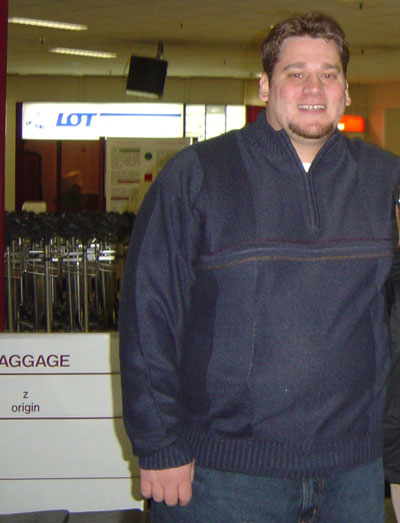
So even after getting to what I was trying to say with this piece, I’m still not entirely sure what I was trying to say with this piece. Truth be told, I came up with the title and went from there, neglecting to truly ground everything that followed in some sort of meaningful coherency. If nothing else, I hope you enjoyed the picture of me with my actual Bar Mitzvah shirt from way back when.
It was May 20, 2000. That’s when.
Having said that, thank you for reading. Check back with me in 13 years, when I’ll be celebrating the Bar Mitzvah of my Bar Mitzvah of my Bar Mitzvah!
Permanent link05/20/2013 The message came over Facebook late Monday night. “I just heard from his cousin. Josh took his own life last night. I am in shock. So sad.”
Josh was a good friend from college. After we graduated, I moved to Chicago, and he moved back home to Ohio. Over time, we lost touch. Sadly, the last time I remembered seeing Josh was 12 years ago, when we drove to Toledo for his brother’s funeral.
Now I found myself sitting at Josh’s funeral with more questions than answers. How does this happen? How could his mother, his sister, his wife, be forced to deal with so much pain? Could I have done anything to stop this? The priest shared some thoughtful insight:
“We have three choices when faced with a tragedy like this. We can be angry with God. We can choose to shut Him out of our lives and refuse to have anything more. I can understand why someone might feel that much anger from this. Second, we can protect God. We can say ‘God needed him’ or ‘he has gone to a better place.’ From my perspective, God does not need protecting, but some will take that perspective. But, we also have a third choice. We can do what we are all doing right now. We can come together, join hands and walk into this mystery side by side.”
It was the most compassionate thing that could have been said. He helped to make sense of what was happening and acknowledged that no one was claiming to know the answers. We simply chose to come together for this service as one and acknowledge the oneness of something more important than each of us individually.
Josh was a lover of music, and because music was such a part of who he was, his cousin looked to music to help everyone cope. She arranged to have two fellow musicians perform the song “Hallelujah” by Leonard Cohen. All week long, nobody had known what to say. There really was nothing that could be said. She wanted to give us a word. Hallelujah means “praise God.” That weekend, it was the word we needed most. Hallelujah!
Permanent linkNaso 9 Sivan 5773 / May 17-18, 2013 05/17/2013 
In this week’s portion, Naso, we find the language Aaron was instructed to use
when blessing the Israelite nation:
יְבָרֶכְךָ יְהוָה
וְיִשְׁמְרֶךָ (Y’-va-re-ch’-cha A-do-nai v’-yish-m’-reh-cha) May God bless
you and guard you;
יָאֵר יְהוָה פָּנָיו
אֵלֶיךָ וִיחֻנֶּךָּ (Ya-eir A-do-nai pa-nav ei-leh-cha vi-chu-neh-kah) May God make
God’s face shine upon you and be gracious unto you;
יִשָּׂא יְהוָה
פָּנָיו אֵלֶיךָ וְיָשֵׂם לְךָ שָׁלוֹם. (Yi-sah A-do-nai pa-nav ei-leh-cha v’-ya-seim
l’-cha sha-lom.) May God lift
up God’s face unto you, and give you peace.
[Numbers 6:24–26]
We find this
blessing still being used regularly today. For example, this is the
blessing traditionally offered by parents to their children at the Shabbat
dinner table on Friday nights. It is often recited for a bride right
before her wedding, and sometimes under the chupah as well for both
bride and groom. It is part of the standard repetition to the Amidah,
and thus for many years has been recited (or at least heard) by observant Jews
on a daily basis.
Is the
blessing one that is familiar to you?
If not, what
are your initial reactions to it?
If so, does
it hold any meaning or power?
Perhaps the
power of the blessing comes less from the words themselves, and more from the
fact that we know Jews have been offering this blessing to one another for over
2,500 years? For me, knowing that the words being offered are the
same as those my ancient ancestors used and received is quite moving, even if
theologically I’m not quite sure that those are the words I’d come up with if
tasked with crafting a blessing to offer to my children in the future.
What is the
value of offering a blessing today? Do we believe that blessings really
contain any sort of power?
On a
metaphysical level, many would argue that a blessing is a form of putting
positive energy out into the universe.
On a more
practical level, I know that before I proposed to my fiancée, I made sure to
ask her parents for their blessing…
If asked to
compose the words that you would use to bless your children, what would they be
and why?
How do they
compare to the blessing we’ve inherited from our ancestors?
This Shabbat,
reflect on the power of blessings – both in form and function. Be in awe
of just how far back in history some of our blessings go. Resolve to
explore meaningful ways to incorporate and when necessary, to create, blessings
that speak to you today.
Permanent link05/14/2013 Last year, while volunteering on MASA Israel Journey—Israel experiential programs sponsored in part by the Jewish Federation of Metropolitan Chicago—in South Tel Aviv, I met an extraordinary friend named Guy. I volunteered with the African refugee community at the African Refugee Development Center (ARDC), a non-profit that helps refugees reach basic social services in Israel. Guy translated for me while I interviewed refugees for their visa applications and *UNHCR resettlement.
Guy is a young man from Darfur who lost his family in the genocide and fled to Israel. Each day, Guy told me his dream was to move to the United States and study at a college. Guy achieved his dream and in December he flew to the US on a student visa. This did not come easily, however. He worked hard and had the courage to ask for help from his friends around the world.

Guy, a Sudanese refugee, and Tamar, an associate with JUF Missions.
Guy recently started school at the College of Lake County in Grayslake, Illinois, through a program at their Center for International Education. I’m sponsoring Guy in Chicago along with a Maya Paley, director of Community Engagement and Special Programs at the National Council of Jewish Women.
Most people ask me about my motivations in helping Guy since I’m young, removed from what’s happening in Israel, and living in Chicago. To be honest, I never saw it as an option to NOT help him. He may come from a completely different background than me—Sudanese, Christian, poor, and traumatized—but he became a very close friend who needed my support.
Guy arrived in the middle of winter with only warm-weather clothes. So, what was my response? Take action. I immediately contacted friends and family across the country to help me with clothing donations. I helped him get acclimated to Chicago (Guy’s first El ride was a loud and crowded experience) and helped him get situated financially.

My Jewish upbringing has given me the moral foundation for sponsoring Guy. Thanks to my parents, who’ve instilled in me the importance of gemilut chasadim, or acts of loving kindness, I’ve always had a passion for helping others. I grew up in a close-knit Jewish community in Milwaukee. My dad is Israeli so we always had Israeli family and friends stay at our home for long periods of time. I grew up sharing everything with my siblings, and we all leaned on each other for help. Throughout high school and college, I participated in B’nai B’rith Youth Organization (BBYO) and the UW-Madison Hillel respectively, which both focus on Jewish leadership, community service and tikkun olam.
After volunteering in Israel with the African refugee community, I settled in Chicago and found a job in the best place for Jewish communal work and charitable giving—the Jewish United Fund. I also spend my Sunday mornings teaching religious school to senior kindergarteners at Chicago’s Anshe Emet Synagogue.
These experiences and positions have grounded my Jewish identity and me. I believe in tzedakah, doing the right thing, giving back, and helping those who are struggling.
Guy came to my doorstep in January and I have not given up trying to help him. The Jewish community I’ve created for myself throughout the years, filled with family, friends and colleagues, have given me the strength and courage to help Guy. He is an amazing person—forthcoming, inspiring and gentle. He speaks highly of Israel—despite the hardships for the African refugee community—and the safety he found there. Some days I’m overwhelmed by the amount of responsibility in sponsoring Guy, but I remind myself that I’m doing the right thing by helping this remarkable person.
Like some of my family who survived the Holocaust, Guy is a survivor of the Darfur genocide and I’m grateful to have him in my life.
Read Guy's story here.
For more information on Guy’s story, email me at tshertok@gmail.com.
Masa Israel Journey is a joint project of the Government of Israel, the Jewish Agency for Israel and its partners, the Jewish Federations of North America, and Keren Hayesod-UJA.
*UNHCR stands for The Office of the United Nations High Commissioner for Refugees.
Tamar Shertok is an associate in the Missions department of the Jewish United Fund/Jewish Federation of Metropolitan Chicago.
Permanent link05/14/2013 
Guy survived the Darfur genocide and found refuge in Israel.
What I have been through is not something one can ever forget. I come from a very poor family, but I believe I have a future: I want to help my people and make Darfur a safer and better place for all people from that region of Sudan. It was my dream to study since I was kid, but I have faced many challenges along the way. I survived the genocide in Darfur.
I came to the United States as a student both because I wanted to study and because I needed a safe place to do so. I was born in 1986 in a village called Mara in Darfur with the name Abdelhamid Yousif Ismail Adem. I am the second of four brothers and three sisters. I recently discovered that one of my brothers is alive, but I do not know whether the rest are alive today. After seeing people being killed in the name of religion, I converted from Islam to Christianity. With this change, I decided to change my name to Guy [JOSIF].
My parents were farmers who cultivated fruits like citrus. We owned cows, goats, sheep, horses, and camels. We were self-reliant. There were around 2,000 people in our village; all of us were farmers. Before the genocide happened I used to help my father and mother in the farm when I returned from school. Unfortunately, I had to stop attending school after grade six. My parents could not afford the fees.
In 2003 our lives changed indefinitely. The war broke out in Darfur and my village was looted and burned. We remained with nothing. One afternoon in August, 2003 we were having tea together and my brothers were playing in front of us. Suddenly nine people with Sudanese military uniforms came into our compound and started beating us. Our village was attacked by around 200 members of the Janjaweed. They came on foot, horse, camels, and cars with machine guns and Kalashnikovs, shooting at every human being in sight. They burned all the houses in our village and took the cattle. I got a chance to escape, but never saw my family again.

While running I met some people from the UN Mine Action office and they stopped and asked me where I was going. I told them that my village was burned and that I left my family there. I told them I was not sure if the villagers survived. I was afraid. I stayed with them while they hid me in their car and went to my village. They saw that everyone was killed and they could not find my family. They took me to their main office in Khartoum where I started working with them as a security guard. There was one man who supported me to go to the Evangelical school in the evenings. I studied from class one up to class four. I continued to the Young Men’s Christian Association Centre then to Abraham Higher School in Bahre where I sat for my high school examination and succeeded.
I began studying at Juba University, Khartoum. After one month, the government created a plan to arrest, imprison, and torture the students from Darfur or South Sudan. Some of my good friends were killed. I was arrested for three months and put in prison, tortured, and beaten. They asked me what I was doing working with the UN. I was released and arrested again and again. The man who had helped me from the UN wrote in the newspaper that he had helped a displaced person from Darfur who had no family. In the article he explained that I was arrested a few times and that bad things had happened to me and he requested my release. The security men released me and told me that I had one week to leave Sudan.
I traveled to Egypt by train where I spent one month before finding people to help me get to Israel. In the evening we were taken by a small bus to a Bedouin camp where I stayed for nine days. We were 23 people from Darfur and Eritrea. Thirteen got killed in front of our eyes; only ten survived and arrived in Israel. The Egyptian border patrol shoots at people randomly. People arrive in Israel with bullet wounds, families are separated at the border, and others lose their lives there.
After all this, I was looking for a place where I can be safe to study and do something for future generations. My dream is that with an education I can create change. Education is the key to life, but in Israel it was too hard to go to school. I was accepted to the College of Lake County in Grayslake, Illinois and have been studying there since January, 2013.
Here in the United States, I can get the education I need to help my people back in Darfur.
Read a story by Guy's sponsor here.
|
Recent Posts
Archive
Sites We Like
|
|
|
Featured Event
 Get real experience from your internship in Israel. Spend 5-10 months kick-starting your career with world-class innovators who won't send you out for coffee. Instead, you'll be a real part of the action. Here at Masa Israel Journey, we don't just help you find the best internships, we also offer funding to help you get there. Go to www.MasaIsrael.org/Intern to see how we can help you find and fund your perfect internship. Start here. Go further.  Sign up for a JUF Chicago community bus this winter. Taglit-Birthright Israel is a FREE 10-day experience of a lifetime. If you are Jewish, 18-26 years old, and have never been on an organized peer program before - let your journey begin! With Shorashim you experience the adventure of Israel through the eyes of Israeli peers. Shorashim is the Taglit-Birthright Israel program where all groups travel for 10-days with Israelis your age. Visit http://israelwithisraelis.com for info.
|
|